Fishing in Los Cabos for Beginners – Your First Fishing Trip Guide
The essentials before your first trip — from a Canadian who's called Los Cabos home since 2014
A Preview of What's Inside the Complete Guide
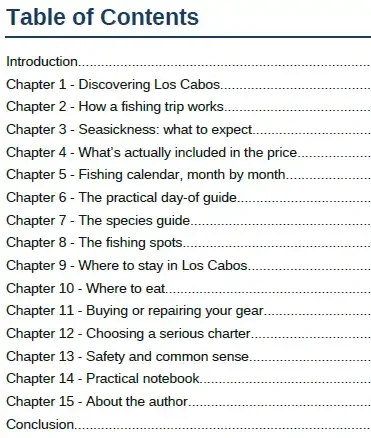
The chapters below are just a preview of what's inside our complete Cabo Fishing Guide. Each chapter in the full guide goes much deeper, with detailed explanations, practical fishing tips, local insights, and expert advice to help you prepare for your fishing adventure in Los Cabos. What you see here is only a taste of the valuable information waiting for you in the complete guide.
## Introduction
Planning a fishing trip to Los Cabos, Mexico? This guide will help you discover what to expect when fishing in Cabo San Lucas, San José del Cabo, and the surrounding waters of Baja California Sur.
Learn about popular species including marlin, yellowfin tuna, dorado, wahoo, and roosterfish, along with seasonal fishing opportunities, charter options, and practical tips for your first trip.
Created by Exotic Fish Cabo, a private sportfishing charter service departing from Puerto Los Cabos Marina in San José del Cabo, this guide brings together local fishing knowledge and useful information for visitors.
Explore the fishing opportunities of Los Cabos and plan an experience that matches your interests, experience level, and travel dates.
My name is Loïc. I'm based in San José del Cabo, captain and owner of Exotic Fish Cabo. I've had hundreds of first-timers on my boat, and I've been answering the same questions for a decade now. Here are the big-picture basics every beginner should know before heading out to sea.
## Chapter 1 — How a Los Cabos fishing trip actually works
Contrary to what you might imagine, you don't need to know how to fish to go out. The vast majority of clients here are first-timers, and the captains are used to doing everything with you, not instead of you.
The typical flow:
1. Early morning departure (often around 6:30 AM) from the marina.
2. Ride out to the fishing grounds — anywhere from 5 minutes to an hour depending on conditions.
3. The captain and mate rig the lines and pick bait based on what's biting that day.
4. You hold the rod, feel the bite, and the crew walks you through the fight.
5. Return around midday or early afternoon, depending on whether you booked a 3/4-day or full-day trip.
The gear, the techniques, the bait selection — all of that is the captain's job. Your only job is to hold the rod and enjoy the ride.
## Chapter 2 — Seasickness: what to expect
This is the question I get asked the most, and it's a fair one. The Sea of Cortez and the Pacific can be glassy or choppy depending on the day and the season.
What actually helps:
- Take Seasickness medication about an hour before departure — not once symptoms have already started, it's too late by then.
- Eat light in the morning, skip the alcohol the night before.
- Stay near the center of the boat, and look at the horizon rather than the water or your phone.
- If you're genuinely prone to it, mention it when booking — some shorter, closer-to-shore routes are calmer.
## Chapter 3— What's actually included in the price
The trip price generally covers: the boat, the captain, the crew, fuel, and basic fishing tackle.
What's generally NOT included, and this is normal in Los Cabos:
- The Mexican fishing license (legally required for anyone over 12 on board, whether they're actively fishing or not), around 20 USD.
- Live bait, between 20 and 40 USD depending on the target species.
- Crew tip — not mandatory but strongly recommended (10 to 15% of the trip price, once for the whole group, not per person).
These aren't hidden fees or a scam — it's simply how the industry works here, and every serious operator runs this way. Bring cash to settle the balance before you head out.
Also worth knowing: sport fishing in Mexico runs on a daily points system by species (big catches like marlin or tuna count for more points than others), selling your catch is prohibited, and authorities do regular checks at the marinas. The full guide breaks down the point value for every species so you know exactly what to expect on the day.
## Chapter 4— The Los Cabos fishing calendar, month by month
Every species has its season. A general overview to help you plan your trip:
- Year-round: striped marlin, mahi mahi depending on conditions, tuna, and roosterfish.
- Summer (May–September): large roosterfish, mahi mahi in abundance, wahoo moving closer to shore.
- Fall (October–December): peak marlin tournament season, active yellowfin tuna.
- Winter (December–March): striped marlin and yellowfin tuna, a quieter but still productive season.
- Spring (April–May): transition season, good mahi mahi and tuna bites ahead of summer.
## Chapter 5 — The practical guide to trip day
- Arrival: be at the marina at the agreed time (usually 6:30 AM) — the boat leaves on schedule.
- What to bring: sunscreen, a hat, sunglasses, a windbreaker or light sweater (mornings are cool before the sun gets high), snacks and water if you want more than what's provided.
- Bring cash for the balance, the license, the bait, and the tip — there's no ATM at the San José del Cabo marina.
- On the way back, your captain can usually arrange a filleting service (at the marina) for your catch — whether you’d like to take it home or have it prepared at a local restaurant. For a flight home, you'll need a proper hard-sided cooler (styrofoam isn't allowed). And Mexican law prohibits filleting on board — that's not the crew being difficult, it's about controlling species at the dock.
## Chapter 6 — The stars of Los Cabos, at a glance
Every species is caught differently, with its own techniques and gear. Here's a taste of what you might come across:
- Striped marlin — the signature fish of Los Cabos, present year-round, mostly caught trolling. A memorable fight for a first big fish.
- Yellowfin tuna — nicknamed "the tank" around here: the best power-to-weight fighter in the region, and likely the most exhausting battle you'll have on this boat.
- Mahi mahi (dorado) — abundant in summer and fall, stunning colors, and excellent on the plate.
- Wahoo — fast and solitary, it calls for a completely different approach than the other trolling species.
- Roosterfish — the region's second signature species, known for spectacular surface fights close to shore. It's our specialty at Exotic Fish Cabo.
- Sailfish — a genuinely elegant fish, and one increasingly worth protecting.
Each species demands its own technique, with matching gear (rod, reel, line, leader, hooks) if you’re bringing your own tackle, plus seasonal nuances. These details — along with tips for choosing the right charter — are exactly what can turn an ordinary outing into a truly memorable experience. That’s what I break down in the full guide below.
Tight lines and have fun,
Loïc — CEO
YOUR FIRST FISHING TRIP TO LOS CABOS STARTS HERE.
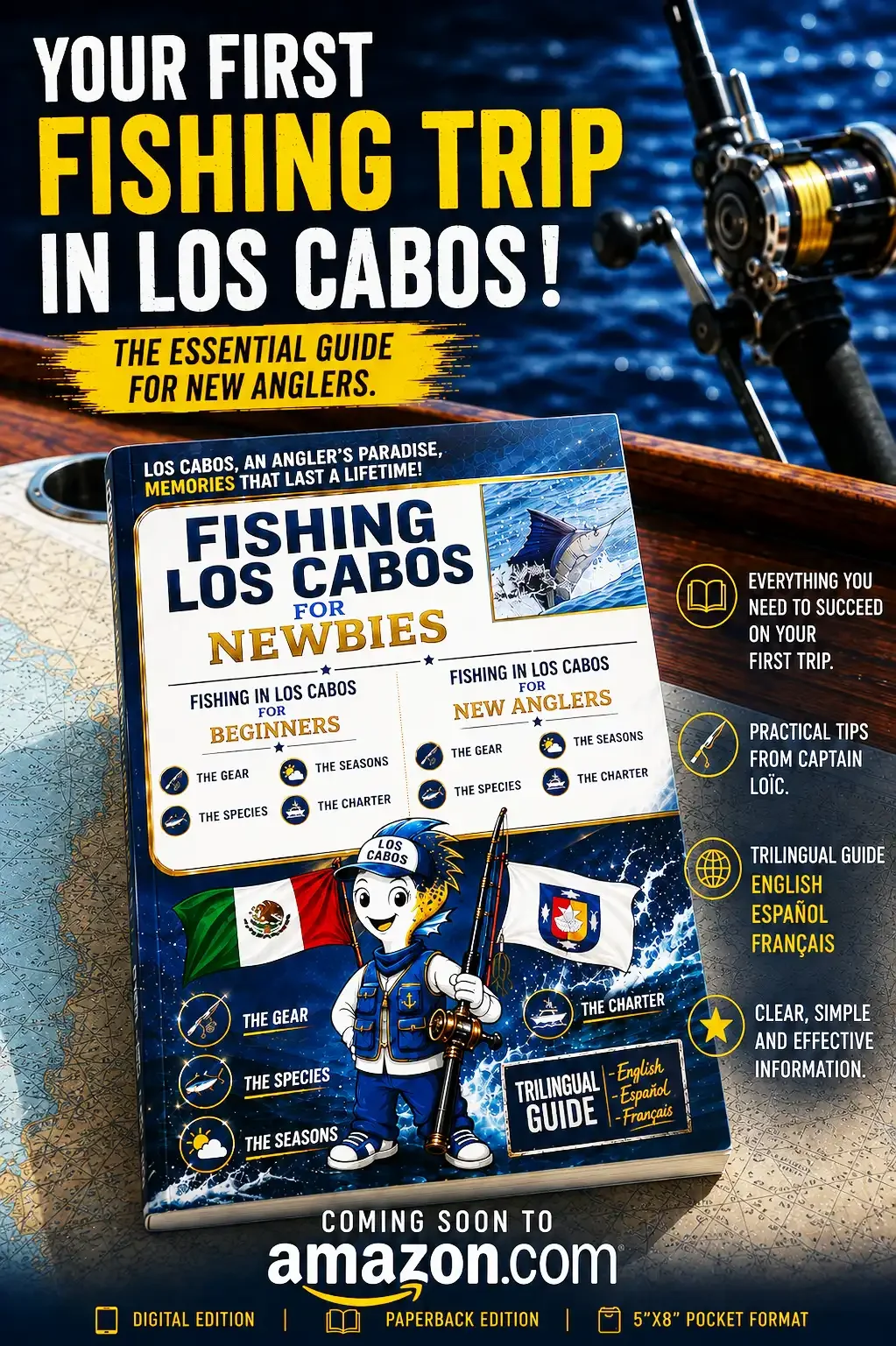
Fishing Los Cabos for Newbies is my full 15 chapters guide — the “Fishing bible” for anyone getting on a boat here for the first time. All 18 species you'll find in Cabo, the exact technique and gear for each, the full points scale by species, and everything else that took me a decade on the water to figure out.
It was written by Me (the owner), a French-Canadian captain who's been fishing the waters of Los Cabos since 2014 — not by someone sitting behind a desk 1,500 km away.